
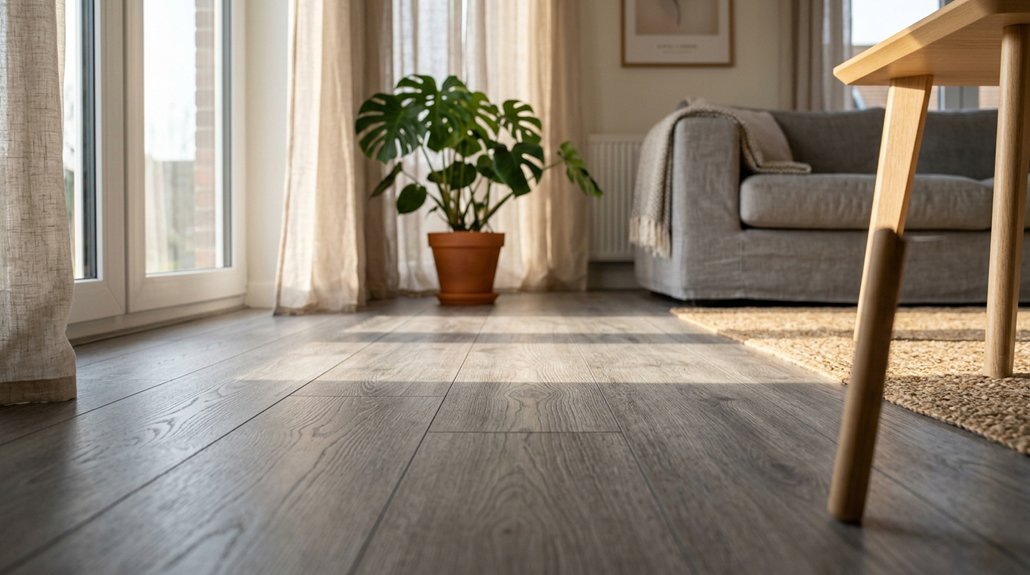


Laminate flooring accounts for roughly 5% of all U.S. flooring sales, yet most buyers can’t tell it apart from real wood at first glance.
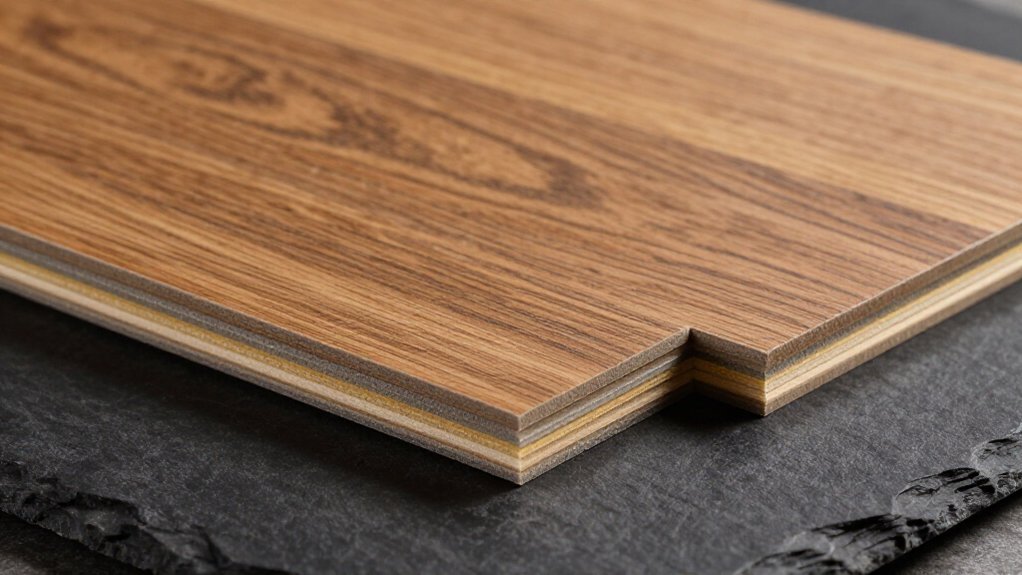
You’re looking at a sandwich of layers: a dense fiberboard core (HDF, or high-density fiberboard, which is basically compressed wood fibers), a photographic print that mimics oak, maple, or stone, and a clear wear layer measured in mils (thousandths of an inch) that resists scratches.
Installations use click-lock edges, so you float the planks over an underlayment without nails or glue. But here’s what separates a floor that lasts 10 years from one that fails in 2…
What Laminate Flooring Is Made Of
What exactly are you walking on when you choose laminate flooring? You’re standing on a multi-layer construction engineered for durability and everyday life. Let’s break it down.
The Four Essential Layers:
- Wear layer: The transparent top shield, made from melamine resin or aluminum oxide in premium options, protects against scratches, stains, and fading from sunlight.
- Decorative layer: A high-resolution printed image beneath the wear layer, giving laminated flooring its realistic wood, stone, or tile appearance.
- Core board: High-density fiberboard (HDF) forms the thick center, providing structural strength and moderate moisture resistance.
- Backing layer: The bottom stabilizer prevents warping and boosts moisture resistance, keeping your floor dimensionally stable.
Some manufacturers add extra moisture-resistant layers between these components. You get predictable performance without surprises.
Recommended Products

【NAACOO UNIVERSAL FLOOR KIT】 4 IN 1 Portable KIT--Tapping Block has unique combination edge design for use with most types of flooring, push tongue and groove wood floor together creating a tight seam, Match Spacers create a uniform gap between the wall. Pull Bar Flooring Tool suitable for work close to a wall, corner, closets or in tight spaces, closing the gaps and seams in laminate floors without causing damage. Rubber mallet can be used with pull bar hook and tapping block, which makes it easier to complete the floor installation work.

【NAACOO Universal Tapping Block】Close gaps during flooring installation, you just put this portable tapping block on the floor tongue, then tapping it, make the tongue and groove or edges of resilient vinyl planks, laminate or hardwood, Joins flooring planks creating tight seam. Whole process without damaging the floor.

🏆【NAACOO UNIVERSAL FLOOR KIT】 5 IN 1 Portable KIT--Tapping Block has unique combination edge design for use with most types of flooring, push tongue and groove wood floor together creating a tight seam, Match Spacers create a uniform gap between the wall. Pull Bar Flooring Tool suitable for work close to a wall, corner, closets or in tight spaces, closing the gaps and seams in laminate floors without causing damage. Contour gauge with lock solves the installation difficulty of the odd-shaped floor. Rubber mallet can be used with pull bar hook and tapping block, which makes it easier to complete the floor installation work.
Laminate vs. Vinyl vs. Engineered Wood
Now that you know what goes into laminate flooring, you’re probably wondering how it stacks up against other popular options.
Laminate features an HDF core, a printed image layer, and a tough wear layer. You’ll install it as a floating installation with click-lock joints over underlayment. Its durability rating AC4 suits busy homes.
Vinyl is fully synthetic, flexible, and generally beats laminate on water resistance. You can glue it down or click it together.
Engineered wood uses real wood veneers over plywood. It looks authentic, but you’ll face trickier installation and higher moisture sensitivity.
Among these flooring materials, laminate hits a practical middle ground. You get easier installation than engineered wood, better rigidity than vinyl, and solid performance, provided you manage moisture carefully.
Recommended Products

Reinforced Mallet: Constructed of cast iron with bright chrome plating, the hammer is equipped with the hardness of 90±5 HAS. The double-faced solid PVC head delivers a softened, positive strike. The mallet head is 1-3/8 inch in diameter. The handle is made of American hickory which is lightweight but tough. The whole mallet is 10-3/4 inch long and weighs 1.036lb.

【Solid double head rubber mallet】: The double faced non marking solid head of rubber mallet made of high carbon steel with bright chrome plating is securely fastened to non slip rubber grip handle,deliver soft and positive strikes,one side of rubber mallet is one rubber,head which prevent damage to the floor,other side of rubber mallet is a plastic head,rubber grip handle absorb vibration.Easy to use and no risk of falling apart and being bent

🏠Thick peel and stick floor tile: Thickness is 0.06inch (1.5mm). Size 12x12 inch included 4 Tiles, made of vinyl. White wood peel and stick floor tile waterproof, renter friendly, groutable, non slip, no special tools needed.
Where Laminate Flooring Works Best (Room by Room)
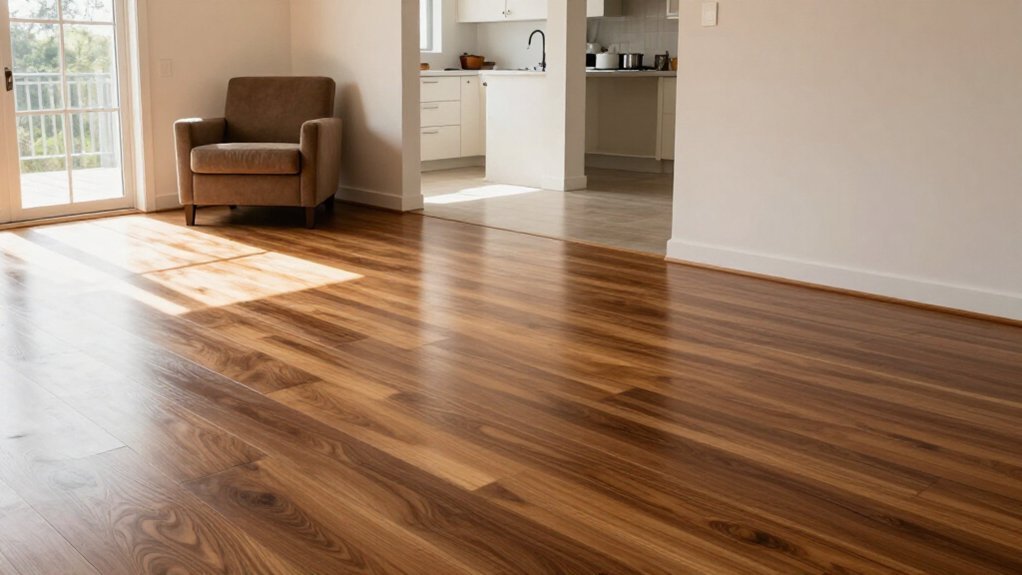
Where should you actually put laminate flooring? You’ll find it excels in living rooms and bedrooms, where high foot traffic meets limited moisture. These spaces let you maximize durability without constant worry.
You can extend laminate flooring into kitchens and hallways, too. Its water resistance handles daily wear, but you’ll need to wipe spills quickly to prevent damage.
For basements or home offices, install a moisture barrier beneath the floating floor system to block ground dampness.
Stairs work with proper transitions, though edge cutting and underlayment quality affect stability and sound.
Your maintenance stays simple: regular sweeping and occasional damp mopping keep surfaces looking sharp. Overall, laminate’s wood-look aesthetics and easy upkeep deliver practical value for rooms prioritizing durability and cost-effectiveness.
Recommended Products

For use under laminate and engineered wood flooring

1/4 INCH & 1/2 INCH DESIGN: The flooring spacers include 1/4 inch and 1/2 inch gaps from the wall, can provide an appropriate expansion gap between the floor and the wall, to avoid damage.

3in1 Vapor Barrier Underlayment | 500 sq. ft bundle (5 rolls each 100 sqft)
Buying Laminate: AC Ratings, Brands, and Warranty Red Flags
How do you cut through the noise when you’re standing in the flooring aisle, staring at dozens of nearly identical boxes? You start with AC ratings. For your home, you’ll want AC4 laminate flooring, which handles residential and light commercial traffic. AC5 or AC6 suits heavier spaces.
You check the wear layer next. Demand clear documentation: thickness in mils or microns, plus years covered. Don’t trust vague warranty terms.
Picture yourself dragging a chair across a thin, peeling surface. Imagine water seeping into seams with no moisture resistance. See a certification seal that proves real independent testing happened. Visualize a denied claim because you missed one exclusion clause.
Stick with brands showing NALFA certification. It confirms tested wear resistance, static load, and scratch standards. Skip anything lacking proof of third-party validation.
Recommended Products

High-Gloss Care for Wood Floors and Furniture Helps enhance shine and reduce the appearance of fine scratches on wood surfaces. Forms a protective finish that helps resist wear, scuffs, moisture, dust, and everyday stains. Leaves a smooth, non-greasy surface designed to maintain good traction and make cleaning easier.
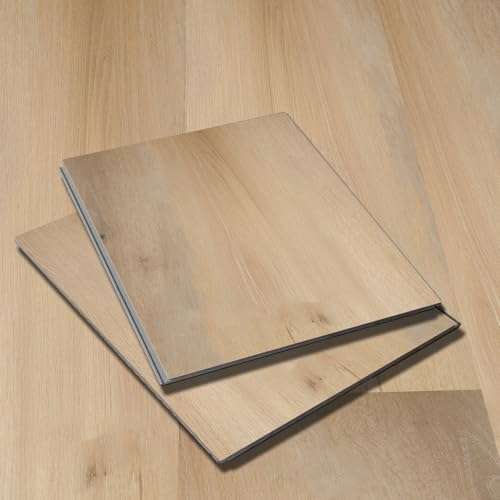
Premium Design-Led Aesthetic: Authentic wood visuals in extra-wide 9” planks and 72” lengths deliver a high-end, modern finish that elevates any space. Micro-beveled edges for a clean, seamless look.

Premium Design-Led Aesthetic: Authentic wood visuals in extra-wide 9” planks and 72” lengths deliver a high-end, modern finish that elevates any space. Micro-beveled edges for a clean, seamless look.