
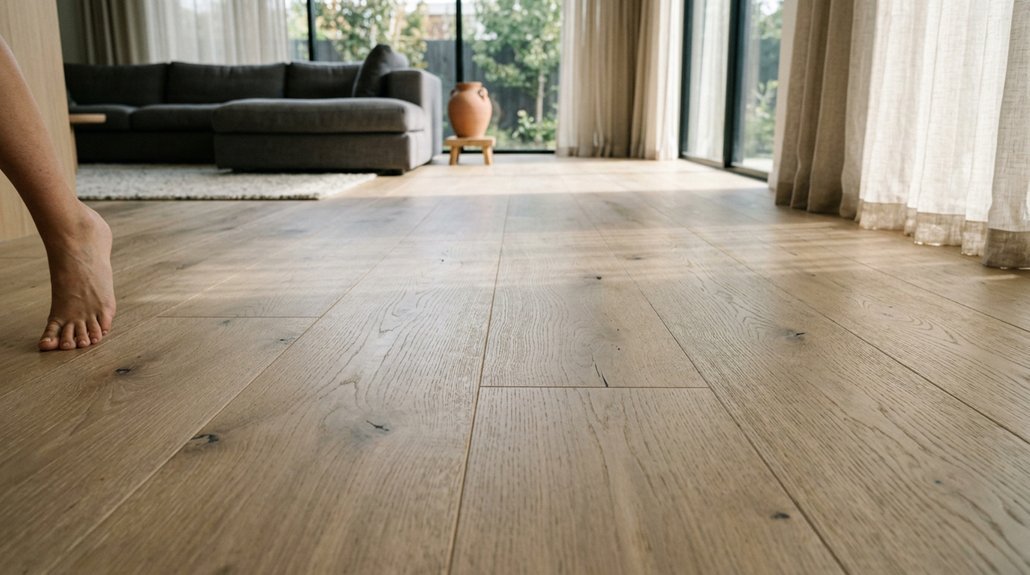


Most shoppers assume engineered flooring means identical construction, but you’ll actually face three distinct build types before you even compare brands. You need to match your subfloor condition, climate, and install skill to the right product, or you’ll waste money on callbacks and repairs. The five options below cut through that confusion, each solving a specific problem: tight spaces, color verification, rental restrictions, warranty coverage, or finished detailing. You won’t find every box checked in one plank, so you’ll want to weigh where your project actually needs help.
HOMELEGEND Gunstock White Oak Engineered Hardwood Flooring

Great tools at a great price
Who needs a compact, workable plank for tight budgets and tighter spaces? You’ll find your answer in HOMELEGEND’s Gunstock White Oak, model HL324H.
Key Specs
- Thickness: 3/8 inch (slim profile, easy transitions)
- Width: 5 inches (classic proportion, versatile styling)
- Coverage: 19.7 square feet per case
What You’re Getting
This engineered hardwood gives you real oak veneer over layered construction. You get stability, you get authenticity, and you don’t get the premium price of solid planks. The 3/8-inch thickness installs well over existing subfloors, including concrete slabs with proper moisture barriers.
Installation Context
You’ll handle this as a floating floor, glue-down, or nail-down application. Acclimate planks 72 hours minimum in the installation space. Check moisture content, check again, then proceed.
Bottom Line
HOMELEGEND delivers pragmatic value here. You sacrifice some refinishing potential, thin veneer limits sanding, but you gain affordability and dimensional stability. For rental properties, basement conversions, or first-time flooring projects, this belongs on your short list.
Best For: Budget-conscious homeowners, DIY first-timers, and rental property investors seeking affordable engineered hardwood for spaces where refinishing longevity is not a priority.
Pros:
- Slim 3/8-inch profile enables easy transitions and installation over existing subfloors including concrete with proper moisture barriers
- Versatile installation methods (floating, glue-down, or nail-down) accommodate various project conditions and skill levels
- Real oak veneer over stable layered construction delivers authentic hardwood appearance at a lower cost than solid planks
Cons:
- Thin veneer significantly limits refinishing potential and sanding options over the product lifespan
- 72-hour acclimation requirement and repeated moisture content checks add preparation time and complexity
- Reduced long-term durability compared to thicker engineered or solid hardwood alternatives makes it less suitable for high-traffic or permanent residential installations
Recommended Products

Easily refill any Bona floor cleaner spray bottle or mop cartridge
Great tools at a great price
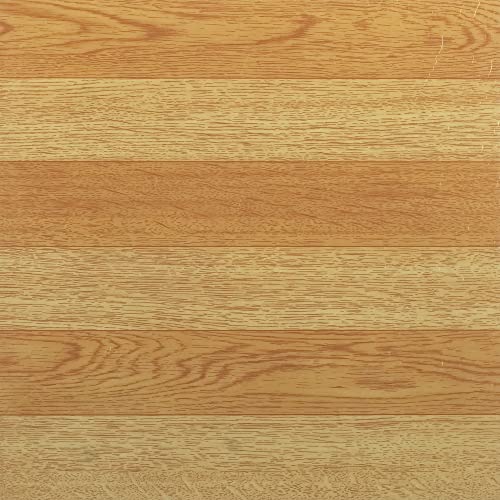
Nexus Vinyl Tiles: Refresh your home for a low cost and no hassle with the Nexus Vinyl Floor Tiles. Our tiles can be used in any room in your home including the kitchen, dining room, bedrooms, bathrooms, foyers, and basements. No messy glue or adhesives needed. Includes 20 vinyl tiles.
Element Flooring Napa Valley White Oak Engineered Hardwood

Crafted from high-quality hardwood, the Napa Valley European White Oak Engineered Hardwood Flooring guarantees unmatched durability and resilience Flooring samples serve as a...
You’re weighing options for a 2026 flooring project, and samples matter more than specs alone. The Element Flooring Napa Valley White Oak engineered hardwood sample lets you judge color and texture under your actual lighting, not showroom bulbs.
Key Specs
- Thickness: 1/2 inch
- Width: 7.5 inches
- Length: 20 to 74.8 inches, varying
- Species: European White Oak
- Color: Crystalline
Why Order This Sample
You hold the real material against your cabinets, paint, and trim. The 7.5 inch width shows plank scale in your room. Varying lengths, up to nearly 75 inches, reveal how the final floor flows, or stalls, in your space.
EFUS builds this engineered hardwood for durability and resilience. The sample confirms whether that “Crystalline” finish reads warm, cool, or flat in your home.
Bottom Line
Order the FCHZA7 sample before committing. It’s cheaper than guessing wrong on a full order.
Best For: Homeowners planning a 2026 flooring renovation who want to verify color, texture, and plank scale under their actual lighting before committing to a full order of engineered hardwood.
Pros:
- Lets you evaluate the “Crystalline” finish warmth and appearance under real home lighting conditions, not showroom bulbs
- 7.5 inch width and varying lengths up to 74.8 inches accurately represent final floor scale and flow in your specific space
- More cost-effective than risking a wrong full order on a high-investment flooring project
Cons:
- Only a sample, not actual installable flooring for immediate use
- Limited to assessing one colorway (Crystalline), requiring separate samples for other options
- Requires additional time and planning delay before main flooring purchase and installation
Recommended Products

Stylized Flooring Solution - Forest Floor Premium Wood Grain Foam Floor Tiles come in interlocking EVA foam tiles, available in 24" x 24" x 3/8" thickness, with a wood grain appearance for a stylized look in any room.

Solid Red Oak Construction – Premium unfinished red oak reducer provides long-lasting strength and a smooth surface for staining or sealing.
Stylized Flooring Solution - Forest Floor Premium Wood Grain Foam Floor Tiles come in interlocking EVA foam tiles, available in 24" x 24" x 3/8" thickness, with a wood grain appearance for a stylized look in any room.
Art3d Peel and Stick Wood Look Vinyl Plank Floor Tiles, 36-Pack, White Oak

Easy Application - Peel and stick for quick and hassle-free installation on any smooth surface Waterproof - Made from premium vinyl, it gracefully resist moisture for...
Need a fast floor fix without the mess? You transform your bedroom or living room in hours, not days, with Art3d’s peel-and-stick vinyl planks.
The Basics
- 36 planks per pack, each measuring 36 x 6 inches
- Brand: Art3d (model A43at122WO36usz)
- White oak color with authentic wood grain texture
Installation
You peel the backing and stick directly onto smooth, clean surfaces. No glue, no nails, no professional help required. You complete typical rooms in a single afternoon.
Performance
Premium vinyl construction delivers waterproof protection, meaning you wipe up spills without worry. The material resists daily wear while maintaining its wood-inspired appearance with minimal upkeep.
Best Fit
You choose this for rental properties, budget renovations, or any space where you need immediate results without long-term commitment.
Best For: Renters, budget-conscious DIY renovators, and homeowners seeking a quick, temporary flooring update without professional installation or long-term commitment.
Pros:
- Fast, mess-free peel-and-stick installation requiring no tools, glue, or professional help
- Waterproof vinyl construction protects against spills and moisture damage
- Authentic wood grain texture provides stylish appearance at a fraction of hardwood cost
Cons:
- Requires smooth, clean surfaces for proper adhesion, limiting application on damaged or uneven subfloors
- 36 x 6 inch plank size may not suit large spaces or those seeking traditional hardwood dimensions
- Peel-and-stick adhesive may not provide permanent durability in high-traffic or commercial environments
Recommended Products

For use as a vapor barrier when installing Vinyl, laminate, SPC and engineered wood flooring

WOOD GRAIN FLOOR MAT (16 Tiles,16 Sq ft, Pine) — Provides comfort and cushion to hard floor surfaces with classic faux wood finish — Includes 16 floor mat wood grain tiles to enhance the comfort and appearance of your space

Elegance Plyquet City Crave Lager White Oak Engineered (Sample Only)

This listing is for 2 pieces of wood floor samples 8" Construction: Engineered Ply Install Type: Floating, Nail Down, or Glue Down Warranty: 50 Year Surface / Lifetime...
Deciding on flooring starts with seeing the real thing in your space. You grab the Elegance Plyquet City Crave Lager sample, two pieces of engineered white oak that show you exactly what you’re buying.
What You Get
- 2 sample pieces, 9/16″ thick, 7″ wide, random lengths up to 84″
- Engineered ply construction (layers of wood bonded together, more stable than solid planks)
- Install three ways: floating, nail down, or glue down
The Numbers That Matter
You get 50 years of surface warranty, lifetime on structure. That’s serious coverage for a generic brand. The color reads random white, so expect natural variation, not uniform factory beige.
Bottom Line
You pay for a sample, not a full box. Smart move. Test it against your walls, your light, your life. Then decide if this 9/16″ engineered plank fits your project. No guesswork, no returns, no regret.
Best For: Homeowners and contractors who want to physically evaluate engineered white oak flooring in their actual space before committing to a full purchase.
Pros:
- Three installation methods (floating, nail down, glue down) provide flexibility for different subfloor conditions and project requirements
- 50-year surface warranty and lifetime structural warranty offer exceptional long-term protection for a generic brand product
- Engineered ply construction delivers superior dimensional stability compared to solid hardwood, reducing expansion and contraction issues
Cons:
- Sample contains only two pieces, limiting ability to assess full color and length variation across a larger installation area
- “Random” color and length description creates uncertainty about final appearance until full order arrives
- Generic brand status may raise questions about manufacturer reputation, consistency, and long-term customer support compared to established flooring brands
Recommended Products

Top Picks, One Kit: featuring Flooret’s bestselling Silvan Engineered Hardwood across our Signature collection 7" Sample Kit—curated to help you find your perfect floor faster. The kit contains cut samples of Anza, Balboa, Evern, Lyon and Norde Signature that are crafted from sustainably sourced European white oak for timeless character and strength.

One 9" Sample Piece of Hurst Hardwoods European French Oak Unfinished Engineered Hardwood Flooring

Top Picks, One Kit: Features the bestselling colors from the Silvan Hardwood 6" Sample Kit—curated to help you find your perfect floor faster. The kit contains cut samples of Anza, Balboa, Evern, Lyon and Norde Signature that are crafted from sustainably sourced European white oak for timeless character and strength.
4×12 Inch Oak Floor Register – Flush Mount Vent

PERFECT FIT GUARANTEE: Designed for 4"x12" duct openings with 6-3/4"x14-1/2" overall frame dimensions - specifically engineered for 3/4" thick hardwood floors with tongue and...
Who benefits most from engineered white oak flooring? You do, if you value seamless integration across every surface detail, including vents.
4×12 Inch Oak Floor Register, Flush Mount Vent
Fit and Installation
You get a perfect fit with this Howeall register: 4×12 inch duct opening, 6-3/4×14-1/2 inch overall frame. You install it flush with your hardwood surface, so no tripping hazard, no visual disruption. You should schedule this during your flooring project, not after. You need basic tools, though professional help streamlines results.
Build Quality
You walk on solid maple construction, 0.75 inches thick. You trust the reinforced louvered design, it supports average adult weight. You place this in high-traffic zones without worry.
Airflow Control
You adjust airflow precisely via the backside damper, black rust-resistant coating ensures smooth sliding for years.
Finish Matching
You sand, stain, or paint the unfinished maple yourself. You match existing white oak flooring exactly. You achieve that seamless, professional look you want.
Best For: Homeowners installing or refinishing white oak hardwood flooring who want a seamless, custom-finished vent that integrates flush with their floor surface.
Pros:
- Unfinished solid maple allows exact staining or painting to match existing flooring
- Flush mount design eliminates tripping hazards and visual disruption
- Reinforced louvered construction supports adult weight for high-traffic durability
Cons:
- Requires finishing work (sanding, staining, or painting) before installation
- Professional installation recommended for optimal results during flooring projects
- Metal damper requires manual adjustment via backside access
Recommended Products

Yesland's 2-in-1 wood flooring spacers for 1/2" & 1/4" gaps meet different gap requirements. Provide appropriate expansion gaps between floor and wall to avoid damage.

Used Book in Good Condition

🇺🇸【No Flooring Mallet Needed】this Heavy Big Tapping Block has enough weight, so tap wood floor directly, to AVOID FINGER CRUSHING by Mallet. Safer installation method !!
Factors to Consider When Choosing Engineered White Oak Flooring

You’ll want to weigh five key factors before buying engineered white oak flooring. Check the thickness (aim for 1/2 inch to 3/4 inch overall), the wear layer (2 millimeters or more lets you refinish later), and whether the core is plywood or high-density fiberboard, which affects stability. Pick your installation method, finish color, and plank dimensions based on your room’s traffic, your skill level, and your timeline.
Recommended Products

Concentrated Wood Soap for Indoor Wood Floors and Surfaces – removes dirt while leaving a microscopic breathable soap layer that helps wood resist drying out and cracking, and makes floors easier to keep clean with regular use

Crafted from high-quality hardwood, the Napa Valley Hickory Engineered Hardwood Flooring guarantees unmatched durability and resilience

Solid Red Oak Construction – Premium unfinished red oak reducer provides long-lasting strength and a smooth surface for staining or sealing.
Thickness and Dimensions
How thick should your engineered white oak flooring be? You’ll find common options at 1/2 inch or 3/8 inch, with 1/2 inch delivering fuller stability and a more solid feel underfoot.
Width and Visual Impact
Widths typically span 5 to 7.5 inches. Wider planks expand the visual scale of your room, while narrower options create tighter, more traditional patterns.
Length Variations
Lengths range from uniform shorter planks to mixed bundles, 20″ to 74.8″, producing varied, natural-looking installations. Randomized lengths add character, though they increase complexity during layout.
Coverage Planning
Check case coverage, around 19.7 square feet for many engineered options, to calculate your total material needs accurately.
Match thickness to your subfloor conditions, width to your room proportions, and length variation to your tolerance for installation time.
Installation Methods
Your engineered white oak flooring isn’t one-size-fits-all when it comes to installation. You’ve got three main paths: floating, nail-down, or glue-down. Each matches different subfloors and product builds.
Floating Installation
You click planks together over an underlayment, skipping adhesive or fasteners entirely. This method buys you speed, simpler removal later, and works well over concrete or existing floors. Check that your chosen product has a click-lock or nail-stud profile designed for this.
Nail-Down Installation
You secure planks through the tongue into a wood subfloor, often with thicker engineered boards (typically 1/2 inch or more). This delivers that solid, traditional feel underfoot. You’ll need proper underlayment and a suitable plywood or OSB base.
Glue-Down Installation
You spread bonding adhesive and set planks directly onto the subfloor. This creates a stable, crack-resistant surface, particularly on concrete slabs.
Before you decide, verify the manufacturer’s specs for thickness limits, stability ratings, and humidity tolerance. Proper bonding depends on matching method to material.
Wear Layer Quality
What separates a floor you’ll replace in fifteen years from one that lasts a lifetime? You guessed it: wear layer quality.
The wear layer is the top real-wood veneer, and its thickness determines how many times you can refinish. Budget engineered white oak often skimps here, giving you a thin slice that won’t survive multiple sanding cycles. You’ll want 1/8 inch at minimum, though 1/4 inch buys you the most longevity.
Here’s what to remember:
- Thicker veneer equals more restoration passes
- Thin layers hit the plywood or fiber core faster
- Occasional refinishing protects your investment
Skip the bargain options unless you’re planning to move soon. You pay more upfront for substantial wear layers, but you’ll avoid full replacement costs down the road. Measure that veneer before you buy.
Finish and Color
Where do you start when the showroom’s full of samples that all look beige? You start by understanding what you’re actually buying.
Engineered white oak spans pale naturals to deep stains. Your existing decor dictates which end of that spectrum works. The top veneer thickness (typically 2-6mm) and finishing coat count determine how many times you’ll refinish. More coats mean better wear resistance.
White oak’s pronounced grain creates natural variation. Expect inconsistency; it’s characteristic, not defective.
Sheen level changes everything:
- Matte: subtle, hides scratches
- Satin: balanced warmth
- Semi-gloss: reflects light, shows wear faster
Pre-finished boards install faster with guaranteed color match. Site-finished lets you customize. Choose based on your timeline and tolerance for dust.
Core Construction
Once you’ve settled on finish and color, flip the board over. Core construction determines how your engineered white oak performs where you cannot see it. You will encounter two main substrates: plywood cores, built from cross-layered wood sheets, and high-density fiberboard (HDF), a compressed wood product. Plywood offers superior dimensional stability, resisting humidity swings that cause warping, and handles impact better over decades. HDF costs less but sacrifices some resilience. Check the wear layer thickness, typically 2mm to 6mm. Thicker veneers tolerate two to four sanding cycles, extending floor life; thinner ones above 2mm allow one refresh at most. Overall thickness matters too, 3/8 inch feels hollow underfoot while 1/2 inch or more dampens sound and improves durability. Choose multi-ply engineered cores for basements or concrete installs, they minimize expansion and contraction.
Budget and Value
How much should you actually spend? Engineered white oak flooring costs less upfront than solid hardwood, and you still get similar looks and durability. That makes it a smart pick for budget-minded projects.
Key Cost Factors:
- Veneer thickness: Thicker veneers (2mm to 6mm) cost more, but you can re-sand them more times, so they last longer.
- Board size: Larger boards with consistent grain reduce waste from cuts, lowering your per-square-foot total.
- Installation method: Floating floors cut labor costs; glue-down and nail-down raise them.
- Warranty length: Longer warranties (25 to 50 years) signal better wear performance. Weigh this against the sticker price.
You determine true value by comparing durability, warranty, and installation costs, not just the initial price tag.